Popular
About this product
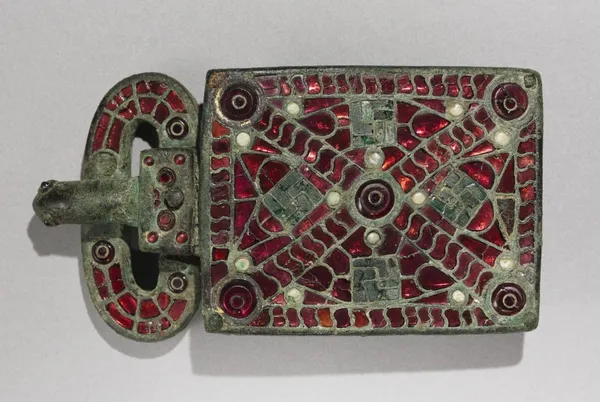
The art of the European Migration Period (3rd-7th centuries AD) is almost exclusively one of personal adornment-a portable art that followed men and women to their graves. Belt buckles with large rectangular attachment plates have been discovered in cemeteries across the Iberian Peninsula-now occupied by Spain and Portugal-from the period of Visigothic occupation (about AD 412-711). Their decoration varies. Finer examples, like this one, are distinguished by brilliantly inlaid semi-precious stones and colored glass. Garnets were especially prized in Visigothic society for use in cloisonné jewelry. The technique involved the fitting of carefully cut pieces of polished garnet into an intricate grid of compartments, or cloisons. This buckle is so densely inlaid with garnets that it presents a virtual "carpet" of red to the eye. These large Visigothic buckles are strikingly uniform in shape yet endlessly varied in surface design, perhaps a sign that they expressed the personal identities of their original owners. Grave excavations have shown that belt buckles of this type were made for women.
Object — Jewelry
Made — c. 525–560
Culture — Visigothic, Spain, Migration Period, 6th century
Technique — bronze with garnets, glass, mother of pearl, gold foil, traces of gilding; bronze and glass
Size — Overall: 7.1 x 2.7 cm (2 13/16 x 1 1/16 in.)
Collection — The Cleveland Museum of Art, 2001.119
Source: The Cleveland Museum of Art · Photo and text: CC0 1.0
Credit: The Cleveland Museum of Art, Purchase from the J. H. Wade Fund
Characteristics
- Manufacturer
- Visigothic