Popular
About this product
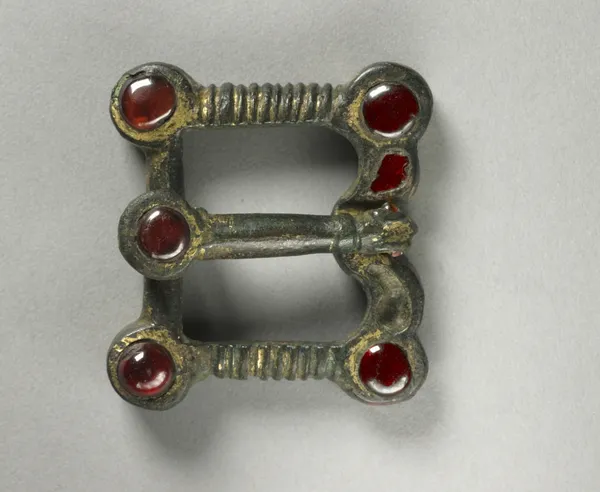
Between the AD 200s and the 600s, the European West is characterized by the so-called "barbarian invasions," a term referring to the movement of various Germanic people into the Roman Empire. The period of the great migrations of these Germanic peoples was one of uncertainty and disorder. By the AD 300s, the collapse of Roman military power in the western provinces was increased by the westward movement of the Huns, an especially fierce enemy from the east. The Huns drove before them displaced Germanic tribes—the Visigoths, Ostrogoths, and Lombards—as they advanced deep into the western provinces. These Germanic peoples were composed of many national groups with diverse customs and traditions. Long nomadic, they gradually settled and took to farming, though always preferring maritime commerce and fishing. They were not attracted to the monumental arts of architecture and sculpture until they had long settled an area. By contrast, the tombs of these migratory people were filled with weapons, tools, and jewelry, often magnificently decorated. The art of the Germanic peoples is almost exclusively one of personal adornment—a portable art that followed men and women to their graves.
Object — Jewelry
Made — 400s CE
Culture — Sarmato-Gothic, Migration period, 5th century
Technique — bronze with traces of gilding and garnets
Size — Overall: 4.3 x 4.5 cm (1 11/16 x 1 3/4 in.)
Collection — The Cleveland Museum of Art, 1981.9
Source: The Cleveland Museum of Art · Photo and text: CC0 1.0
Credit: The Cleveland Museum of Art, In memory of William M. Milliken
Characteristics
- Manufacturer
- Sarmato-Gothic