Popular
About this product
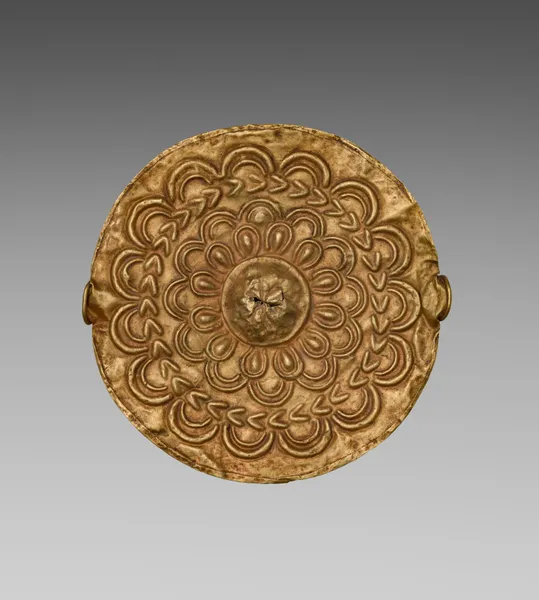
Gold discs dangling on the chests of Akan state officials and elites showed their rank and duties. Worn by these akrafo (“soul people”) since the 1800s, they are often linked to kradware, officials who represent and purify (“wash”) the king’s soul. To make them, goldsmiths cast or flattened gold. Muslim North African gold coins likely inspired their form and material, while concentric water rings influenced their composition. This small disc is a typical pre-colonial example: asantehene (king) Prempeh I reportedly owned this disk. The British emptied his treasury after deposing and exiling him in 1896. Gold ornament making ceased until 1924; court officials now wear large discs.
Object — Jewelry
Made — 1800s, before 1896
Culture — Africa, West Africa, Ghana, Asante Empire/Kingdom, probably Kumasi, member of the goldsmiths’ guild
Technique — Gold
Size — Diameter: 9.8 cm (3 7/8 in.); Overall: 1.3 cm (1/2 in.)
Collection — The Cleveland Museum of Art, 1935.310
Source: The Cleveland Museum of Art · Photo and text: CC0 1.0
Credit: The Cleveland Museum of Art, Dudley P. Allen Fund
Characteristics
- Manufacturer
- Africa