Popular
Low stock
About this product
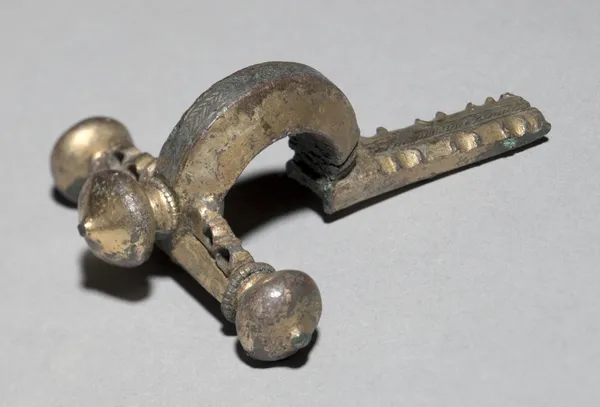
A fibula was a garment clasp that functioned somewhat like a modern safety pin. Since buttons were not used in antiquity, fibulae were used to keep a cloak closed. They were worn by both men and women, commonly on the right shoulder, and produced in various sizes and shapes. Because they were highly visible accessories, they often received decorative gilding, inlay decoration, or onion-shaped domes. Crossbow fibulae were introduced by the Romans and are named for their resemblance to the weapon. Decorative and technical features suggest this may have been made in Roman-occupied Britain.
Object — Jewelry
Made — c. 350–400
Culture — Gallo-Roman or Romano-British, Migration period, 4th century
Technique — bronze, gilt-bronze, silver, and niello
Size — Overall: 10.2 x 7.1 x 3.8 cm (4 x 2 13/16 x 1 1/2 in.)
Collection — The Cleveland Museum of Art, 1930.227
Source: The Cleveland Museum of Art · Photo and text: CC0 1.0
Credit: The Cleveland Museum of Art, Purchase from the J. H. Wade Fund
Characteristics
- Manufacturer
- Gallo-Roman