About this product
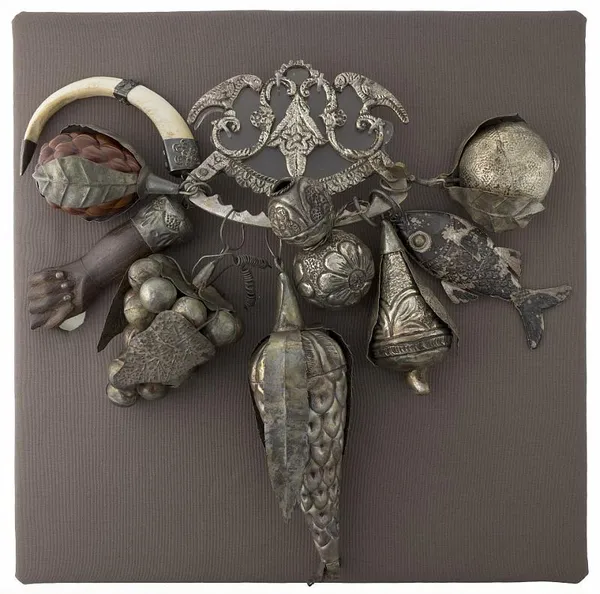
A piece of charm jewelry, penca de balangandã, comprised of a metal main body, the nave, and nine charm pendants and typically worn around the waist with a strip of cloth or chain.; The nave is a triangular shaped body divided into two parts horizontally and held together by a hinge and butterfly screw. The top part of the nave is symmetrical with an elaborate, decorative, botanical motif on the solid design with large empty spaces. A chain would have been weaved through these empty spaces or the upper most part. The topmost part is flanked by birds with closed wings. The lower part of the nave is semicircular and denticulated where the pendants are located. The face of the denticulated curve has a smooth texture.; The nine charms are: a boar tusk with three bands at each end and the middle; a wooden fist stained darker and with copper fingernails; a raffia palm nut surrounded by four metal leaves; a bunch of grapes with leaves; a plant, possible corn, with spiky leaves at the top and flared out ends; a cylinder formed from two stacked spheres, resembling a pomegranate, and with a floral motif; a cashew apple; a fish with copper eyes; and an orange/mandarin with leaves.
Object — amulets talismans charms
Made — 19th century
Culture — African Americans; Africans
Place — Brazil, Latin America, South America; Bahia, Brazil, Latin America, South America
Materials — tin plated copper, raffia palm nut, boar's tooth, wood
Size — H x W x D: 13 × 10 × 2 1/2 in. (33 × 25.4 × 6.4 cm)
Collection — National Museum of African American History and Culture
Source: National Museum of African American History and Culture · Photo and text: CC0 1.0
Credit: National Museum of African American History and Culture, Collection of the Smithsonian National Museum of African American History and Culture, Gift in honor of Marion Kumala Lockard
Characteristics
- Manufacturer
- African Americans